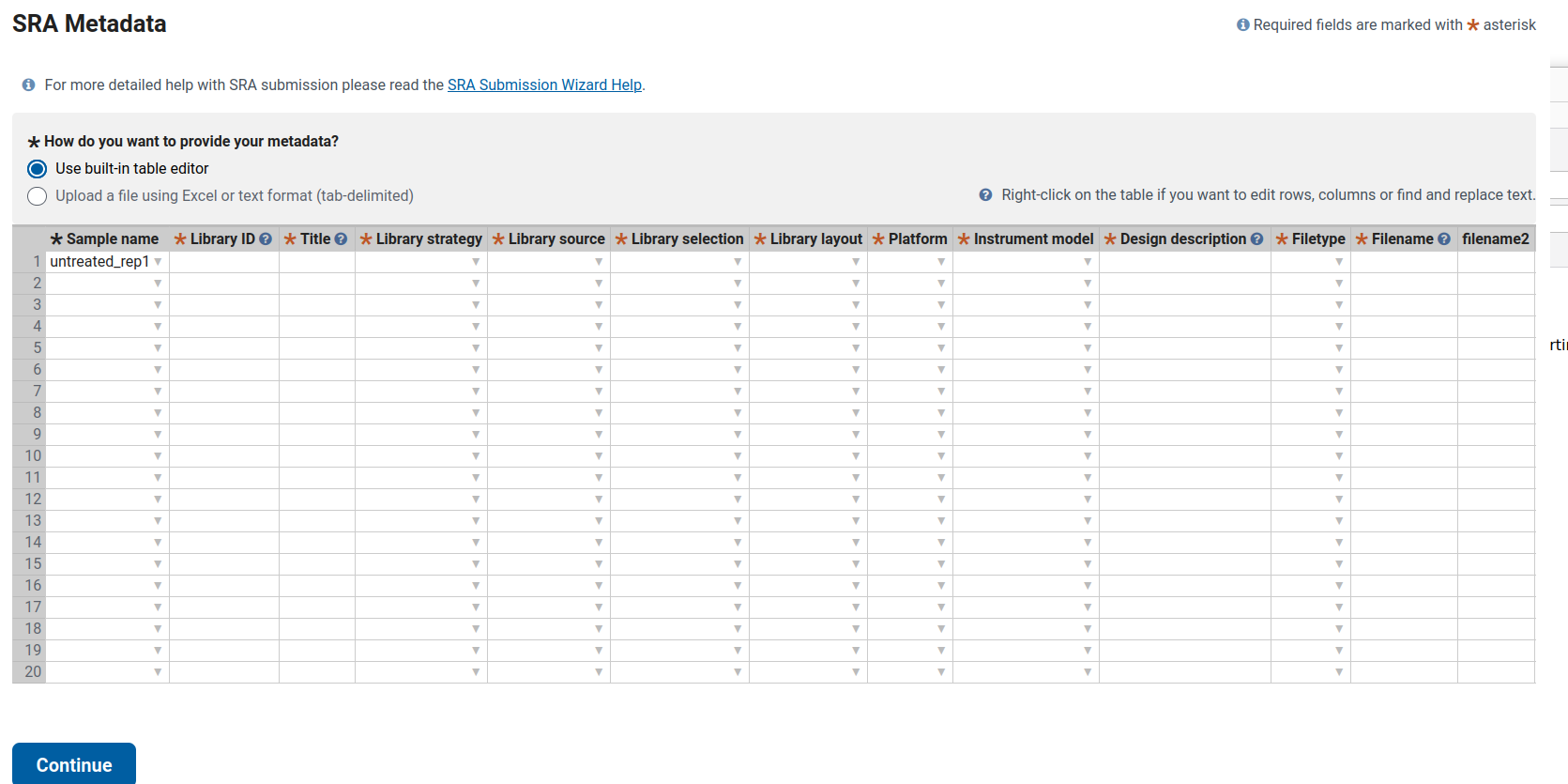
This guide explains how to complete the SRA metadata table for ten bulk RNA-seq samples derived from human skin organoids (SkOs). It includes one fully filled example row and shows the pattern to follow for the remaining samples.
Columns That Are the Same for All 10 Samples
According to the Methods section, all samples correspond to bulk RNA-seq using Lexogen RiboCop rRNA depletion and the Lexogen RNA-Seq V2 library kit. Sequencing was performed as single-end 1×83 bp reads on the Illumina NextSeq 500.
Therefore, the following columns remain identical for all samples (untreated_rep1 … HSV_d8_rep2):
- Library strategy: RNA-Seq
- Library source: TRANSCRIPTOMIC
- Library selection: RANDOM (rRNA-depleted total RNA; “RANDOM” is the standard choice)
- Library layout: SINGLE
- Platform: ILLUMINA
- Instrument model: Illumina NextSeq 500
- Filetype: fastq (use this if uploading *.fastq.gz; otherwise, select the matching file type)
Columns That Differ Per Sample
- Sample name
This information comes from BioSample (e.g.,
untreated_rep1,HSV_d4_rep2, etc.). - Library ID Each row must have a unique internal ID. You can use a simple sequential pattern:
untreated_rep1 → LIB01
untreated_rep2 → LIB02
HSV_d2_rep1   → LIB03
…
HSV_d8_rep2   → LIB10
Alternatively, a more descriptive format such as SkO_bulk_untreated_rep1 is acceptable. The key requirement is that all IDs are unique.
- Title Use the following pattern: Bulk RNA-seq of human skin organoid (SkO), CONDITION, replicate X
Examples:
untreated_rep1 → Bulk RNA-seq of human skin organoid (SkO), untreated, replicate 1
untreated_rep2 → Bulk RNA-seq of human skin organoid (SkO), untreated, replicate 2
HSV_d2_rep1   → Bulk RNA-seq of human skin organoid (SkO) infected with Human alphaherpesvirus 1 (HSV-1), 2 dpi, replicate 1
HSV_d4_rep2   → Bulk RNA-seq of human skin organoid (SkO) infected with Human alphaherpesvirus 1 (HSV-1), 4 dpi, replicate 2
Repeat this pattern for 6 dpi and 8 dpi samples.
- Design description
Use this base text and modify it per condition:
Bulk RNA-seq of human hair-bearing skin organoids (SkOs) derived from hiPSC line UKEi001-A. Total RNA from two organoids per condition was pooled, depleted of rRNA (Lexogen RiboCop rRNA Depletion Kit for Human/Mouse/Rat V2), and libraries were prepared with the Lexogen RNA-Seq V2 Library Prep Kit with UDIs (short insert variant). Libraries were sequenced as 1×83 bp single-end reads on an Illumina NextSeq 500.
Then append the condition information as follows:
- For untreated rows: Condition: untreated control.
- For HSV_d2 rows: Condition: skin organoids infected with Human alphaherpesvirus 1 (HSV-1) for 2 days (2 dpi).
- For HSV_d4 rows: Condition: skin organoids infected with Human alphaherpesvirus 1 (HSV-1) for 4 days (4 dpi).
- Continue the same pattern for 6 dpi and 8 dpi.
- Filename / filename2
Since this dataset is single-end, only the Filename column is required.
- Filetype: fastq
- Filename: must match the exact uploaded file name, e.g.:
untreated_rep1 → untreated_rep1.fastq.gz
untreated_rep2 → untreated_rep2.fastq.gz
HSV_d2_rep1   → HSV_d2_rep1.fastq.gz
…
- **filename2:** leave blank (used only for paired-end libraries).Example: Completed Row (untreated_rep1)
| Column | Example Entry |
|---|---|
| Sample name | untreated_rep1 |
| Library ID | LIB01 |
| Title | Bulk RNA-seq of human skin organoid (SkO), untreated, replicate 1 |
| Library strategy | RNA-Seq |
| Library source | TRANSCRIPTOMIC |
| Library selection | RANDOM |
| Library layout | SINGLE |
| Platform | ILLUMINA |
| Instrument model | Illumina NextSeq 500 |
| Design description | Bulk RNA-seq of human hair-bearing skin organoids (SkOs) derived from hiPSC line UKEi001-A. Total RNA from two organoids per condition was pooled, depleted of rRNA (Lexogen RiboCop rRNA Depletion Kit for Human/Mouse/Rat V2) and libraries were prepared with the Lexogen RNA-Seq V2 Library Prep Kit with UDIs (short insert variant). Libraries were sequenced as 1×83 bp single-end reads on an Illumina NextSeq 500. Condition: untreated control. |
| Filetype | fastq |
| Filename | untreated_rep1.fastq.gz |
| filename2 | (blank) |
After completing this first row, copy and adjust the fields (Library ID, Title, Design description condition, and Filename) for the other nine samples accordingly.