Daily Archives: 2026年1月14日

Workflow using PICRUSt2 for Data_Karoline_16S_2025 (v2)

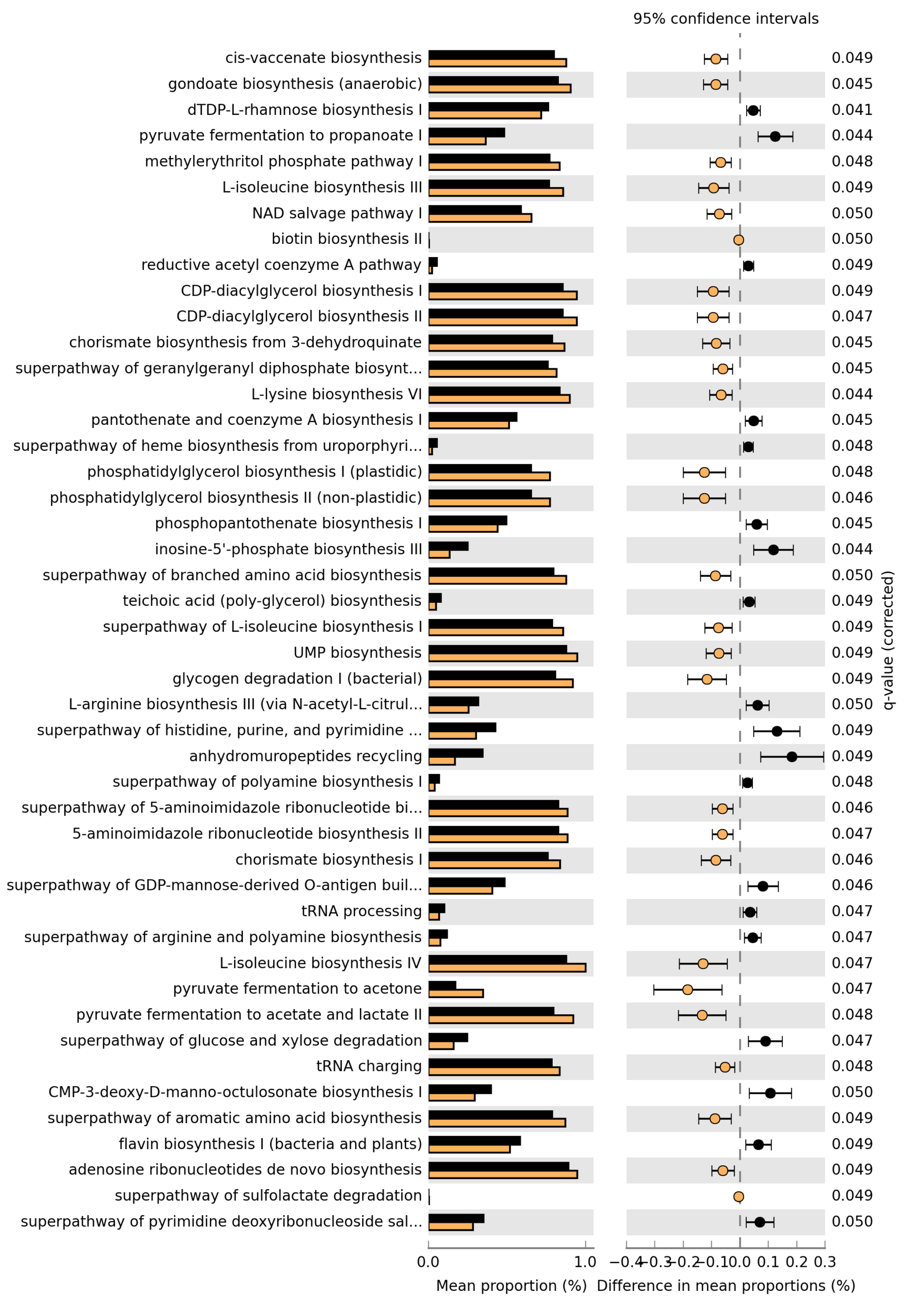
  • Welchs_t-test
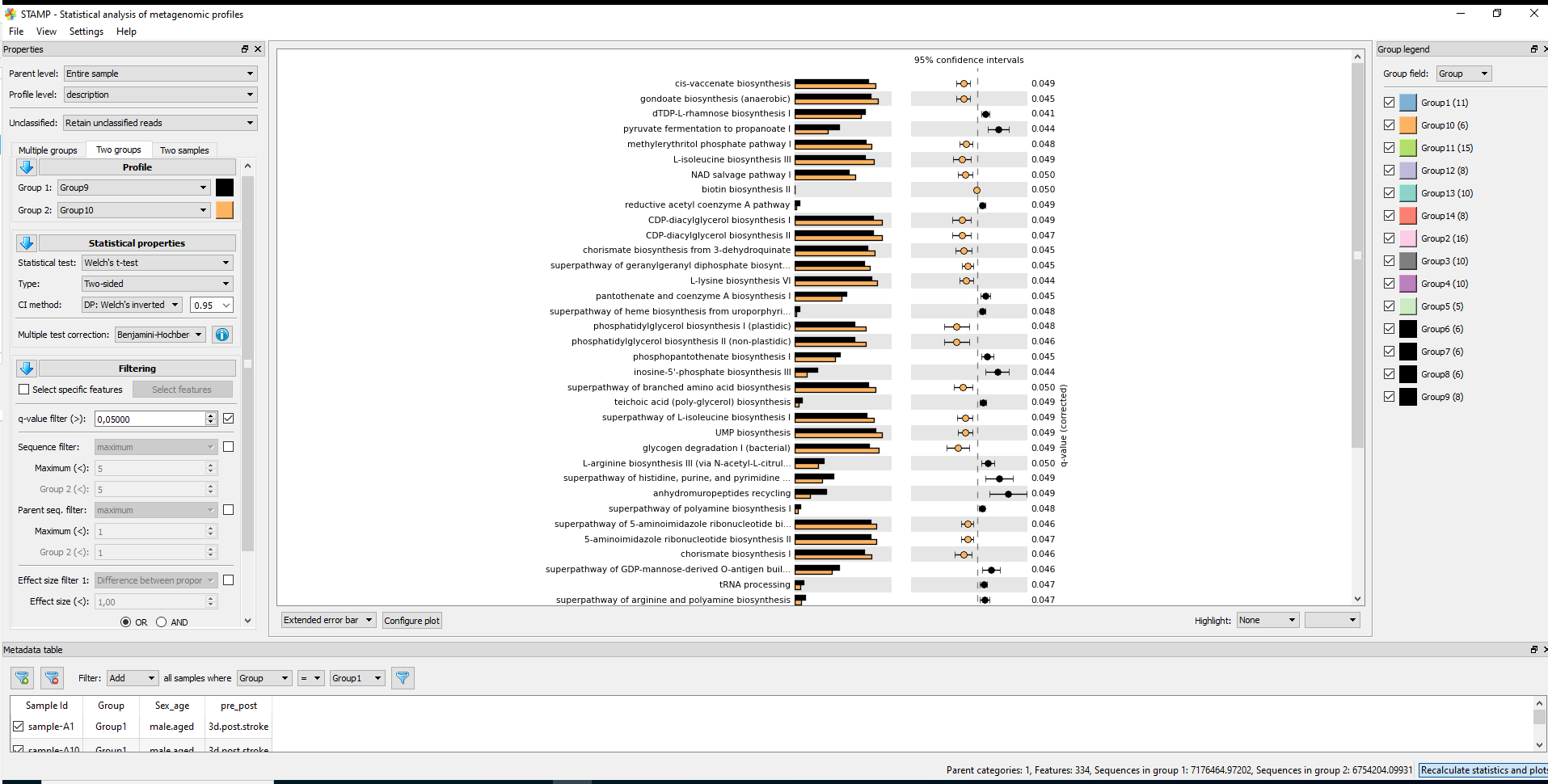
  • STAMP_Screenshot
  1. Environment Setup: It sets up a Conda environment named picrust2, using the conda create command and then activates this environment using conda activate picrust2.

    #https://github.com/picrust/picrust2/wiki/PICRUSt2-Tutorial-(v2.2.0-beta)#minimum-requirements-to-run-full-tutorial
    mamba create -n picrust2 -c bioconda -c conda-forge picrust2    #2.5.3  #=2.2.0_b
    mamba activate /home/jhuang/miniconda3/envs/picrust2

Under docker-env (qiime2-amplicon-2023.9)

  1. Export QIIME2 feature table and representative sequences

    #docker pull quay.io/qiime2/core:2023.9
    #docker run -it --rm \
    #-v /mnt/md1/DATA/Data_Karoline_16S_2025:/data \
    #-v /home/jhuang/REFs:/home/jhuang/REFs \
    #quay.io/qiime2/core:2023.9 bash
    #cd /data
    # === SETTINGS ===
    FEATURE_TABLE_QZA="dada2_tests2/test_7_f240_r240/table.qza"
    REP_SEQS_QZA="dada2_tests2/test_7_f240_r240/rep-seqs.qza"
    
    # === STEP 1: EXPORT QIIME2 ARTIFACTS ===
    mkdir -p qiime2_export
    qiime tools export --input-path $FEATURE_TABLE_QZA --output-path qiime2_export
    qiime tools export --input-path $REP_SEQS_QZA --output-path qiime2_export
  2. Convert BIOM to TSV for Picrust2 input

    biom convert \
    -i qiime2_export/feature-table.biom \
    -o qiime2_export/feature-table.tsv \
    --to-tsv

Under env (picrust2): mamba activate /home/jhuang/miniconda3/envs/picrust2

  1. Run PICRUSt2 pipeline

    tail -n +2 qiime2_export/feature-table.tsv > qiime2_export/feature-table-fixed.tsv
    picrust2_pipeline.py \
    -s qiime2_export/dna-sequences.fasta \
    -i qiime2_export/feature-table-fixed.tsv \
    -o picrust2_out \
    -p 100
    
    #This will:
    #* Place sequences in the reference tree (using EPA-NG),
    #* Predict gene family abundances (e.g., EC, KO, PFAM, TIGRFAM),
    #* Predict pathway abundances.
    
    #In current PICRUSt2 (with picrust2_pipeline.py), you do not run hsp.py separately.
    #Instead, picrust2_pipeline.py internally runs the HSP step for all functional categories automatically. It outputs all the prediction files (16S_predicted_and_nsti.tsv.gz, COG_predicted.tsv.gz, PFAM_predicted.tsv.gz, KO_predicted.tsv.gz, EC_predicted.tsv.gz, TIGRFAM_predicted.tsv.gz, PHENO_predicted.tsv.gz) in the output directory.
    
    mkdir picrust2_out_advanced; cd picrust2_out_advanced
    #If you still want to run hsp.py manually (advanced use / debugging), the commands correspond directly:
    hsp.py -i 16S -t ../picrust2_out/out.tre -o 16S_predicted_and_nsti.tsv.gz -p 100 -n
    hsp.py -i COG -t ../picrust2_out/out.tre -o COG_predicted.tsv.gz -p 100
    hsp.py -i PFAM -t ../picrust2_out/out.tre -o PFAM_predicted.tsv.gz -p 100
    hsp.py -i KO -t ../picrust2_out/out.tre -o KO_predicted.tsv.gz -p 100
    hsp.py -i EC -t ../picrust2_out/out.tre -o EC_predicted.tsv.gz -p 100
    hsp.py -i TIGRFAM -t ../picrust2_out/out.tre -o TIGRFAM_predicted.tsv.gz -p 100
    hsp.py -i PHENO -t ../picrust2_out/out.tre -o PHENO_predicted.tsv.gz -p 100
  2. Metagenome prediction per functional category (if needed separately)

    #cd picrust2_out_advanced
    metagenome_pipeline.py -i ../qiime2_export/feature-table.biom -m 16S_predicted_and_nsti.tsv.gz -f COG_predicted.tsv.gz -o COG_metagenome_out --strat_out
    metagenome_pipeline.py -i ../qiime2_export/feature-table.biom -m 16S_predicted_and_nsti.tsv.gz -f EC_predicted.tsv.gz -o EC_metagenome_out --strat_out
    metagenome_pipeline.py -i ../qiime2_export/feature-table.biom -m 16S_predicted_and_nsti.tsv.gz -f KO_predicted.tsv.gz -o KO_metagenome_out --strat_out
    metagenome_pipeline.py -i ../qiime2_export/feature-table.biom -m 16S_predicted_and_nsti.tsv.gz -f PFAM_predicted.tsv.gz -o PFAM_metagenome_out --strat_out
    metagenome_pipeline.py -i ../qiime2_export/feature-table.biom -m 16S_predicted_and_nsti.tsv.gz -f TIGRFAM_predicted.tsv.gz -o TIGRFAM_metagenome_out --strat_out
    
    # Add descriptions in gene family tables
    add_descriptions.py -i COG_metagenome_out/pred_metagenome_unstrat.tsv.gz -m COG -o COG_metagenome_out/pred_metagenome_unstrat_descrip.tsv.gz
    add_descriptions.py -i EC_metagenome_out/pred_metagenome_unstrat.tsv.gz -m EC -o EC_metagenome_out/pred_metagenome_unstrat_descrip.tsv.gz
    add_descriptions.py -i KO_metagenome_out/pred_metagenome_unstrat.tsv.gz -m KO -o KO_metagenome_out/pred_metagenome_unstrat_descrip.tsv.gz   # EC and METACYC is a pair, EC for gene_annotation and METACYC for pathway_annotation
    add_descriptions.py -i PFAM_metagenome_out/pred_metagenome_unstrat.tsv.gz -m PFAM -o PFAM_metagenome_out/pred_metagenome_unstrat_descrip.tsv.gz
    add_descriptions.py -i TIGRFAM_metagenome_out/pred_metagenome_unstrat.tsv.gz -m TIGRFAM -o TIGRFAM_metagenome_out/pred_metagenome_unstrat_descrip.tsv.gz
  3. Pathway inference (MetaCyc pathways from EC numbers)

    #cd picrust2_out_advanced
    pathway_pipeline.py -i EC_metagenome_out/pred_metagenome_contrib.tsv.gz -o EC_pathways_out -p 100
    pathway_pipeline.py -i EC_metagenome_out/pred_metagenome_unstrat.tsv.gz -o EC_pathways_out_per_seq -p 100 --per_sequence_contrib --per_sequence_abun EC_metagenome_out/seqtab_norm.tsv.gz --per_sequence_function EC_predicted.tsv.gz
    #ERROR due to missing .../pathway_mapfiles/KEGG_pathways_to_KO.tsv
    pathway_pipeline.py -i COG_metagenome_out/pred_metagenome_contrib.tsv.gz -o KEGG_pathways_out -p 100 --no_regroup --map /home/jhuang/anaconda3/envs/picrust2/lib/python3.6/site-packages/picrust2/default_files/pathway_mapfiles/KEGG_pathways_to_KO.tsv
    pathway_pipeline.py -i KO_metagenome_out/pred_metagenome_strat.tsv.gz -o KEGG_pathways_out -p 100 --no_regroup --map /home/jhuang/anaconda3/envs/picrust2/lib/python3.6/site-packages/picrust2/default_files/pathway_mapfiles/KEGG_pathways_to_KO.tsv
    
    add_descriptions.py -i EC_pathways_out/path_abun_unstrat.tsv.gz -m METACYC -o EC_pathways_out/path_abun_unstrat_descrip.tsv.gz
    gunzip EC_pathways_out/path_abun_unstrat_descrip.tsv.gz
    
    #Error - no rows remain after regrouping input table. The default pathway and regroup mapfiles are meant for EC numbers. Note that KEGG pathways are not supported since KEGG is a closed-source database, but you can input custom pathway mapfiles if you have access. If you are using a custom function database did you mean to set the --no-regroup flag and/or change the default pathways mapfile used?
    #If ERROR --> USE the METACYC for downstream analyses!!!
    
    #ERROR due to missing .../description_mapfiles/KEGG_pathways_info.tsv.gz
    #add_descriptions.py -i KO_pathways_out/path_abun_unstrat.tsv.gz -o KEGG_pathways_out/path_abun_unstrat_descrip.tsv.gz --custom_map_table /home/jhuang/anaconda3/envs/picrust2/lib/python3.6/site-packages/picrust2/default_files/description_mapfiles/KEGG_pathways_info.tsv.gz
    
    #NOTE: Target-analysis for the pathway "mixed acid fermentation"
  4. Visualization

    #7.1 STAMP
    #https://github.com/picrust/picrust2/wiki/STAMP-example
    #Note that STAMP can only be opened under Windows
    
    # It needs two files: path_abun_unstrat_descrip.tsv.gz as "Profile file" and metadata.tsv as "Group metadata file".
    cp ~/DATA/Data_Karoline_16S_2025/picrust2_out_advanced/EC_pathways_out/path_abun_unstrat_descrip.tsv ~/DATA/Access_to_Win10/
    
    cut -d$'\t' -f1 qiime2_metadata.tsv > 1
    cut -d$'\t' -f3 qiime2_metadata.tsv > 3
    cut -d$'\t' -f5-6 qiime2_metadata.tsv > 5_6
    paste -d$'\t' 1 3 > 1_3
    paste -d$'\t' 1_3 5_6 > metadata.tsv
    #SampleID --> SampleID
    SampleID        Group   pre_post        Sex_age
    sample-A1       Group1  3d.post.stroke  male.aged
    sample-A2       Group1  3d.post.stroke  male.aged
    sample-A3       Group1  3d.post.stroke  male.aged
    cp ~/DATA/Data_Karoline_16S_2025/metadata.tsv ~/DATA/Access_to_Win10/
    # MANULLY_EDITING: keeping the only needed records in metadata.tsv: Group 9 (J1–J4, J10, J11) and Group 10 (K1–K6).
    
    #7.2. ALDEx2
    https://bioconductor.org/packages/release/bioc/html/ALDEx2.html

Under docker-env (qiime2-amplicon-2023.9)

  1. (NOT_NEEDED) Convert pathway output to BIOM and re-import to QIIME2 gunzip picrust2_out/pathways_out/path_abun_unstrat.tsv.gz biom convert \ -i picrust2_out/pathways_out/path_abun_unstrat.tsv \ -o picrust2_out/path_abun_unstrat.biom \ –table-type=”Pathway table” \ –to-hdf5

    qiime tools import \
    --input-path picrust2_out/path_abun_unstrat.biom \
    --type 'FeatureTable[Frequency]' \
    --input-format BIOMV210Format \
    --output-path path_abun.qza
    
    #qiime tools export --input-path path_abun.qza --output-path exported_path_abun
    #qiime tools peek path_abun.qza
    echo "✅ PICRUSt2 pipeline complete. Output in: picrust2_out"
  2. Short answer: unless you had a very clear, pre-specified directional hypothesis, you should use a two-sided test.

    A bit more detail:
    
    * Two-sided t-test
    
            * Tests: “Are the means different?” (could be higher or lower).
            * Standard default in most biological and clinical studies and usually what reviewers expect.
            * More conservative than a one-sided test.
    
    * One-sided t-test
    
            * Tests: “Is Group A greater than Group B?” (or strictly less than).
            * You should only use it if before looking at the data you had a strong reason to expect a specific direction and you would ignore/consider uninterpretable a difference in the opposite direction.
            * Using one-sided just to gain significance is considered bad practice.
    
    For your pathway analysis (exploratory, many pathways, q-value correction), the safest and most defensible choice is to:
    
    * Use a two-sided t-test (equal variance or Welch’s, depending on variance assumptions).
    
    So I’d recommend rerunning STAMP with Type: Two-sided and reporting those results.
    
    #--> Using a two-sided Welch's t-test in STAMP, that is the unequal-variance version (does not assume equal variances and is more conservative than “t-test (equal variance)” referring to the classical unpaired Student’s t-test.
  3. Statistics in STAMP

    * For multiple groups:
        * Statistical test: ANOVA, Kruskal-Wallis H-test
        * Post-hoc test: Games-Howell, Scheffe, Tukey-Kramer, Welch's (uncorrected) (by default 0.95)
        * Effect size: Eta-squared
        * Multiple test correction: Benjamini-Hochberg FDR, Bonferroni, No correction
    * For two groups
        * Statistical test: t-test (equal variance), Welch's t-test, White's non-parametric t-test
        * Type: One-sided, Two-sided
        * CI method: "DP: Welch's inverted" (by default 0.95)
        * Multiple test correction: Benjamini-Hochberg FDR, Bonferroni, No correction, Sidak, Storey FDR
    * For two samples
        * Statistical test: Bootstrap, Chi-square test, Chi-square test (w/Yates'), Difference between proportions, Fisher's exact test, G-test, G-test (w/Yates'), G-test (w/Yates') + Fisher's, Hypergeometric, Permutation
        * Type: One-sided, Two-sided
        * CI method: "DP: Asymptotic", "DP: Asymptotic-CC", "DP: Newcomber-Wilson", "DR: Haldane adjustment", "RP: Asymptotic" (by default 0.95)
        * Multiple test correction: Benjamini-Hochberg FDR, Bonferroni, No correction, Sidak, Storey FDR
  4. Since MetaCyc does not have a single pathway explicitly named “short-chain fatty acid biosynthesis”, I defined a small SCFA-related set (acetate-, propionate- and butyrate-producing pathways) and tested these between Group 9 and Group 10 (Welch’s t-test, with BH correction within this subset). These pathways can also be found in the file Welchs_t-test.xlsx attached to my email from 26.11.2025 (for Group9 (J1-4, J6-7, J10-11) vs Group10 (K1-6)).

Pathway ID  Description     Group 9 mean (%)    Group 10 mean (%)   p-value     p-adj (BH, SCFA set)
P108-PWY    pyruvate fermentation to propanoate I   0.5070  0.3817  0.001178    0.0071
PWY-5100    pyruvate fermentation to acetate and lactate II     0.8354  0.9687  0.007596    0.0228
CENTFERM-PWY    pyruvate fermentation to butanoate  0.0766  0.0410  0.026608    0.0532
PWY-5677    succinate fermentation to butanoate     0.0065  0.0088  0.365051    0.5476
P163-PWY    L-lysine fermentation to acetate and butanoate  0.0324  0.0271  0.484704    0.5816
PWY-5676    acetyl-CoA fermentation to butanoate II     0.1397  0.1441  0.927588    0.9276

In this SCFA-focused set, the propionate (P108-PWY) and acetate (PWY-5100) pathways remain significantly different between Group 9 and Group 10 after adjustment, whereas the butyrate-related pathways do not show clear significant differences (CENTFERM-PWY is borderline).

from 14.01.2026 (for Group9 (J1-4, J10-11) vs Group10 (K1-6)), marked green in the Excel-files.

Pathway ID  Description Group 9 mean (%)    Group 10 mean (%)   p-value p-adj (BH, 6-pathway set)
P108-PWY    pyruvate fermentation to propanoate I   0.5142  0.3817  0.001354    0.008127
PWY-5100    pyruvate fermentation to acetate and lactate II 0.8401  0.9687  0.008763    0.026290
CENTFERM-PWY    pyruvate fermentation to butanoate  0.0729  0.0410  0.069958    0.139916
PWY-5677    succinate fermentation to butanoate 0.0063  0.0088  0.367586    0.551379
P163-PWY    L-lysine fermentation to acetate and butanoate  0.0308  0.0271  0.693841    0.832609
PWY-5676    acetyl-CoA fermentation to butanoate II 0.1421  0.1441  0.971290    0.971290
  1. Reporting

    Please find attached the results of the pathway analysis. The Excel file contains the full statistics for all pathways; those with adjusted p-values (Benjamini–Hochberg) ≤ 0.05 are highlighted in yellow and are the ones illustrated in the figure.
    
    The analysis was performed using Welch’s t-test (two-sided) with Benjamini–Hochberg correction for multiple testing.

browse the 141 pipelines that are currently available as part of nf-core on 2026-01-14

Count check

  • Input pipeline count: 141
  • Output pipeline count (below): 141 ✅
  • Categories: 16
  • Sum of category counts: 141 ✅

Categorized pipelines (with counts)

1) Bulk RNA-seq & transcriptomics (19)

alleleexpression, cageseq, circrna, denovotranscript, differentialabundance, drop, dualrnaseq, evexplorer, isoseq, lncpipe, nanostring, nascent, rnafusion, rnaseq, rnasplice, rnavar, riboseq, slamseq, stableexpression

2) Small RNA-seq (1)

smrnaseq

3) Single-cell transcriptomics (6)

marsseq, scdownstream, scflow, scnanoseq, scrnaseq, smartseq2

4) Spatial omics (6)

molkart, panoramaseq, pixelator, sopa, spatialvi, spatialxe

5) Chromatin & regulation (10)

atacseq, callingcards, chipseq, clipseq, cutandrun, hic, hicar, mnaseseq, sammyseq, tfactivity

6) DNA methylation (3)

methylarray, methylong, methylseq

7) Human genomics, variants & disease (22)

abotyper, circdna, deepvariant, eager, exoseq, gwas, longraredisease, mitodetect, oncoanalyser, pacvar, phaseimpute, radseq, raredisease, rarevariantburden, rnadnavar, sarek, ssds, tumourevo, variantbenchmarking, variantcatalogue, variantprioritization, createpanelrefs

8) Viruses & pathogen surveillance (7)

pathogensurveillance, phageannotator, tbanalyzer, viralmetagenome, viralintegration, viralrecon, vipr

9) Metagenomics & microbiome (10)

ampliseq, coproid, createtaxdb, detaxizer, funcscan, mag, magmap, metapep, metatdenovo, taxprofiler

10) Genome assembly, annotation & comparative genomics (14)

bacass, bactmap, denovohybrid, genomeannotator, genomeassembler, genomeqc, genomeskim, hgtseq, multiplesequencealign, neutronstar, pangenome, pairgenomealign, phyloplace, reportho

11) Immunology & antigen presentation (4)

airrflow, epitopeprediction, hlatyping, mhcquant

12) Proteomics, metabolomics & protein informatics (11)

ddamsproteomics, diaproteomics, kmermaid, metaboigniter, proteinannotator, proteinfamilies, proteinfold, proteogenomicsdb, proteomicslfq, quantms, ribomsqc

13) Imaging & other experimental modalities (7)

cellpainting, imcyto, liverctanalysis, lsmquant, mcmicro, rangeland, troughgraph

14) Data acquisition, QC & ops / utilities (12)

bamtofastq, datasync, demo, demultiplex, fastqrepair, fastquorum, fetchngs, nanoseq, readsimulator, references, seqinspector, seqsubmit

15) Genome editing & screens (2)

crisprseq, crisprvar

16) Other methods / modelling / non-bioinformatics (7)

deepmodeloptim, deepmutscan, diseasemodulediscovery, drugresponseeval, meerpipe, omicsgenetraitassociation, spinningjenny


Category Name Short description 中文描述 Released Stars Last release
Bulk RNA-seq & transcriptomics alleleexpression Allele-specific expression (ASE) analysis using STAR-WASP, UMI-tools, phaser 等位基因特异性表达(ASE)分析:STAR-WASP 比对,UMI-tools 去重,phaser 单倍型分相与 ASE 检测 2
Bulk RNA-seq & transcriptomics cageseq CAGE-sequencing analysis pipeline with trimming, alignment and counting of CAGE tags. CAGE-seq 分析:剪切、比对并统计 CAGE 标签(转录起始相关)。 11 1.0.2
Bulk RNA-seq & transcriptomics circrna circRNA quantification, differential expression analysis and miRNA target prediction of RNA-Seq data 环状 RNA(circRNA)定量、差异表达分析及 miRNA 靶标预测。 59
Bulk RNA-seq & transcriptomics denovotranscript de novo transcriptome assembly of paired-end short reads from bulk RNA-seq 基于 bulk RNA-seq 双端短读长的从头转录组组装。 19 1.2.1
Bulk RNA-seq & transcriptomics differentialabundance Differential abundance analysis for feature/observation matrices (e.g., RNA-seq) 对特征/观测矩阵做差异丰度分析(可用于表达矩阵等)。 87 1.5.0
Bulk RNA-seq & transcriptomics drop Pipeline to find aberrant events in RNA-Seq data, useful for diagnosis of rare disorders RNA-seq 异常事件检测流程(用于罕见病诊断等)。 7
Bulk RNA-seq & transcriptomics dualrnaseq Analysis of Dual RNA-seq data (host-pathogen interactions) 宿主-病原双 RNA-seq 分析流程,用于研究宿主-病原相互作用。 25 1.0.0
Bulk RNA-seq & transcriptomics evexplorer Analyze RNA data from extracellular vesicles; QC, region detection, normalization, DRE 胞外囊泡(EV)RNA 数据分析:质控、表达区域检测、归一化与差异 RNA 表达(DRE)。 1
Bulk RNA-seq & transcriptomics isoseq Genome annotation with PacBio Iso-Seq from raw subreads to FLNC and bed annotation PacBio Iso-Seq 基因组注释:从 subreads 生成 FLNC 并产出 bed 注释。 50 2.0.0
Bulk RNA-seq & transcriptomics lncpipe Analysis of long non-coding RNAs from RNA-seq datasets (under development) lncRNA(长链非编码 RNA)分析流程(开发中)。 34
Bulk RNA-seq & transcriptomics nanostring Analysis pipeline for Nanostring nCounter expression data. Nanostring nCounter 表达数据分析流程。 16 1.3.1
Bulk RNA-seq & transcriptomics nascent Nascent Transcription Processing Pipeline 新生转录(nascent RNA)处理与分析流程。 22 2.3.0
Bulk RNA-seq & transcriptomics rnafusion RNA-seq analysis pipeline for detection of gene-fusions RNA-seq 融合基因检测流程。 170 4.0.0
Bulk RNA-seq & transcriptomics rnaseq RNA sequencing pipeline (STAR/RSEM/HISAT2/Salmon) with QC and counts 常规 bulk RNA-seq 分析:比对/定量/计数与全面质控(多比对/定量器可选)。 1179 3.22.2
Bulk RNA-seq & transcriptomics rnasplice RNA-seq alternative splicing analysis RNA-seq 可变剪接分析流程。 63 1.0.4
Bulk RNA-seq & transcriptomics rnavar gatk4 RNA variant calling pipeline 基于 GATK4 的 RNA 变异检测(RNA variant calling)。 58 1.2.2
Bulk RNA-seq & transcriptomics riboseq Analysis of ribosome profiling (Ribo-seq) data Ribo-seq(核糖体测序/核糖体 footprinting)分析流程。 21 1.2.0
Bulk RNA-seq & transcriptomics slamseq SLAMSeq processing and analysis pipeline SLAM-seq(新生 RNA 标记)处理与分析流程。 10 1.0.0
Bulk RNA-seq & transcriptomics stableexpression Identify stable genes across datasets; useful for RT-qPCR reference genes 寻找最稳定基因(适合作为 RT-qPCR 参考内参基因)。 5
Small RNA-seq smrnaseq A small-RNA sequencing analysis pipeline 小 RNA 测序(如 miRNA 等)分析流程。 98 2.4.1
Single-cell transcriptomics marsseq MARS-seq v2 pre-processing pipeline with velocity MARS-seq v2 预处理流程,支持 RNA velocity。 8 1.0.3
Single-cell transcriptomics scdownstream Single cell transcriptomics pipeline for QC, integration, presentation 单细胞转录组下游:质控、整合与结果展示。 81
Single-cell transcriptomics scflow Please consider using/contributing to nf-core/scdownstream 单细胞流程(建议转向/贡献 scdownstream)。 25
Single-cell transcriptomics scnanoseq Single-cell/nuclei pipeline for Oxford Nanopore + 10x Genomics 单细胞/细胞核测序流程:结合 ONT 与 10x 数据。 52 1.2.1
Single-cell transcriptomics scrnaseq Single-cell RNA-Seq pipeline (10x/DropSeq/SmartSeq etc.) 单细胞 RNA-seq 主流程:支持 10x、DropSeq、SmartSeq 等。 310 4.1.0
Single-cell transcriptomics smartseq2 Process single cell RNA-seq generated with SmartSeq2 SmartSeq2 单细胞 RNA-seq 处理流程。 15
Spatial omics molkart Processing Molecular Cartography data (Resolve Bioscience combinatorial FISH) Resolve Molecular Cartography(组合 FISH)数据处理流程。 14 1.2.0
Spatial omics panoramaseq Pipeline to process sequencing-based spatial transcriptomics data (in-situ arrays) 测序型空间转录组(in-situ arrays)数据处理流程。 0
Spatial omics pixelator Pipeline to generate Molecular Pixelation data (Pixelgen) Pixelgen 分子像素化(Molecular Pixelation)数据处理流程。 13 2.3.0
Spatial omics sopa Nextflow version of Sopa – spatial omics pipeline and analysis Sopa 的 Nextflow 实现:空间组学流程与分析。 11
Spatial omics spatialvi Process spatial gene counts + spatial coordinates + image data (10x Visium) 10x Visium 空间转录组处理:基因计数+空间坐标+图像数据。 70
Spatial omics spatialxe (no description shown) 空间组学相关流程(原表未给出描述)。 24
Chromatin & regulation atacseq ATAC-seq peak-calling and QC analysis pipeline ATAC-seq 峰识别与质控分析流程。 221 2.1.2
Chromatin & regulation callingcards A pipeline for processing calling cards data Calling cards 实验数据处理流程。 6 1.0.0
Chromatin & regulation chipseq ChIP-seq peak-calling, QC and differential analysis ChIP-seq 峰识别、质控与差异分析流程。 229 2.1.0
Chromatin & regulation clipseq CLIP-seq QC, mapping, UMI deduplication, peak-calling options CLIP-seq 分析:质控、比对、UMI 去重与多种 peak calling。 24 1.0.0
Chromatin & regulation cutandrun CUT&RUN / CUT&TAG pipeline with QC, spike-ins, IgG controls, peak calling CUT&RUN/CUT&TAG 分析:质控、spike-in、IgG 对照、峰识别与下游。 106 3.2.2
Chromatin & regulation hic Analysis of Chromosome Conformation Capture (Hi-C) data Hi-C 染色体构象捕获数据分析流程。 105 2.1.0
Chromatin & regulation hicar HiCAR multi-omic co-assay pipeline HiCAR 多组学共测(转录+染色质可及性+接触)分析流程。 12 1.0.0
Chromatin & regulation mnaseseq MNase-seq analysis pipeline using BWA and DANPOS2 MNase-seq 分析流程(BWA + DANPOS2)。 12 1.0.0
Chromatin & regulation sammyseq SAMMY-seq pipeline to analyze chromatin state SAMMY-seq 染色质状态分析流程。 5
Chromatin & regulation tfactivity Identify differentially active TFs using expression + open chromatin 整合表达与开放染色质数据,识别差异活跃转录因子(TF)。 12
DNA methylation methylarray Illumina methylation array processing; QC, confounders, DMP/DMR, cell comp optional Illumina 甲基化芯片分析:预处理、质控、混杂因素检查、DMP/DMR;可选细胞组成估计与校正。 6
DNA methylation methylong Extract methylation calls from long reads (ONT/PacBio) 从长读长(ONT/PacBio)提取甲基化识别结果。 19 2.0.0
DNA methylation methylseq Bisulfite-seq methylation pipeline (Bismark/bwa-meth + MethylDackel/rastair) 亚硫酸氢盐测序甲基化分析流程(Bismark/bwa-meth 等)。 185 4.2.0
Human genomics, variants & disease abotyper Characterise human blood group and red cell antigens using ONT 基于 ONT 的人类血型与红细胞抗原分型/鉴定流程。 1
Human genomics, variants & disease circdna Identify extrachromosomal circular DNA (ecDNA) from Circle-seq/WGS/ATAC-seq 从 Circle-seq/WGS/ATAC-seq 识别染色体外环状 DNA(ecDNA)。 31 1.1.0
Human genomics, variants & disease createpanelrefs Generate Panel of Normals / models / references from many samples 从大量样本生成 PoN(Panel of Normals)/模型/参考资源。 11
Human genomics, variants & disease deepvariant Consider using/contributing to nf-core/sarek DeepVariant 相关(建议使用/贡献至 sarek)。 40 1.0
Human genomics, variants & disease eager Ancient DNA analysis pipeline 古 DNA(aDNA)分析流程(可重复、标准化)。 195 2.5.3
Human genomics, variants & disease exoseq Please consider using/contributing to nf-core/sarek Exo-seq 相关(建议使用/贡献至 sarek)。 16
Human genomics, variants & disease gwas UNDER CONSTRUCTION: Genome Wide Association Studies GWAS(全基因组关联分析)流程(建设中)。 27
Human genomics, variants & disease longraredisease Long-read sequencing pipeline for rare disease variant discovery 长读长测序罕见病变异识别流程(神经发育障碍等)。 5 v1.0.0-alpha
Human genomics, variants & disease mitodetect A-Z analysis of mitochondrial NGS data 线粒体 NGS 数据全流程分析。 7
Human genomics, variants & disease oncoanalyser Comprehensive cancer DNA/RNA analysis and reporting pipeline 肿瘤 DNA/RNA 综合分析与报告生成流程。 97 2.3.0
Human genomics, variants & disease pacvar Long-read PacBio sequencing processing for WGS and PureTarget PacBio 长读长 WGS/PureTarget 测序数据处理流程。 13 1.0.1
Human genomics, variants & disease phaseimpute Phase and impute genetic data 遗传数据分相与基因型填补流程。 27 1.1.0
Human genomics, variants & disease radseq Variant-calling pipeline for RADseq RADseq 变异检测流程。 7
Human genomics, variants & disease raredisease Call and score variants from WGS/WES of rare disease patients 罕见病 WGS/WES 变异检测与打分流程。 112 2.6.0
Human genomics, variants & disease rarevariantburden Summary count based rare variant burden test (e.g., vs gnomAD) 基于汇总计数的稀有变异负担检验(可与 gnomAD 等对照)。 0
Human genomics, variants & disease rnadnavar Integrated RNA+DNA somatic mutation detection RNA+DNA 联合分析的体细胞突变检测流程。 14
Human genomics, variants & disease sarek Germline/somatic variant calling + annotation from WGS/targeted WGS/靶向测序的生殖系/体细胞变异检测与注释(含预处理、calling、annotation)。 532 3.7.1
Human genomics, variants & disease ssds Single-stranded DNA Sequencing (SSDS) pipeline SSDS(单链 DNA 测序)分析流程。 1
Human genomics, variants & disease tumourevo Model tumour clonal evolution from WGS (CN, subclones, signatures) 基于 WGS 的肿瘤克隆进化建模(CN、亚克隆、突变签名等)。 20
Human genomics, variants & disease variantbenchmarking Evaluate/validate variant calling accuracy 变异检测方法准确性评估与验证流程(benchmark)。 37 1.4.0
Human genomics, variants & disease variantcatalogue Generate population variant catalogues from WGS 从 WGS 构建人群变异目录(变异列表及频率)。 13
Human genomics, variants & disease variantprioritization (no description shown) 变异优先级筛选流程(原表未给出描述)。 12
Viruses & pathogen surveillance pathogensurveillance Surveillance of pathogens using population genomics and sequencing 基于群体基因组与测序的病原体监测流程。 52 1.0.0
Viruses & pathogen surveillance phageannotator Identify, annotate, quantify phage sequences in (meta)genomes 在(宏)基因组中识别、注释并定量噬菌体序列。 17
Viruses & pathogen surveillance tbanalyzer Pipeline for Mycobacterium tuberculosis complex analysis 结核分枝杆菌复合群(MTBC)分析流程。 13
Viruses & pathogen surveillance viralmetagenome Untargeted viral genome reconstruction with iSNV detection from metagenomes 宏基因组中无靶向病毒全基因组重建,并检测 iSNV。 28 1.0.1
Viruses & pathogen surveillance viralintegration Identify viral integration events using chimeric reads 基于嵌合 reads 的病毒整合事件检测流程。 17 0.1.1
Viruses & pathogen surveillance viralrecon Viral assembly and intrahost/low-frequency variant calling 病毒组装与宿主体内/低频变异检测流程。 151 3.0.0
Viruses & pathogen surveillance vipr Viral assembly and intrahost/low-frequency variant calling 病毒组装与体内/低频变异检测流程(类似 viralrecon)。 14
Metagenomics & microbiome ampliseq Amplicon sequencing workflow using DADA2 and QIIME2 扩增子测序(如 16S/ITS)分析:DADA2 + QIIME2。 231 2.15.0
Metagenomics & microbiome coproid Coprolite host identification pipeline 粪化石(coprolite)宿主鉴定流程。 13 2.0.0
Metagenomics & microbiome createtaxdb Automated construction of classifier databases for multiple tools 自动化并行构建多种宏基因组分类工具的数据库。 20 2.0.0
Metagenomics & microbiome detaxizer Identify (and optionally remove) sequences; default remove human 识别并(可选)去除特定序列(默认去除人源污染)。 22 1.3.0
Metagenomics & microbiome funcscan (Meta-)genome screening for functional and natural product genes (宏)基因组功能基因与天然产物基因簇筛查。 99 3.0.0
Metagenomics & microbiome mag Assembly and binning of metagenomes 宏基因组组装与分箱(MAG 构建)。 264 5.3.0
Metagenomics & microbiome magmap Mapping reads to large collections of genomes 将 reads 比对到大型基因组集合的最佳实践流程。 10 1.0.0
Metagenomics & microbiome metapep From metagenomes to epitopes and beyond 从宏基因组到表位(epitope)等免疫相关下游分析。 12 1.0.0
Metagenomics & microbiome metatdenovo De novo assembly/annotation of metatranscriptomic or metagenomic data 宏转录组/宏基因组的从头组装与注释(支持原核/真核/病毒)。 34 1.3.0
Metagenomics & microbiome taxprofiler Multi-taxonomic profiling of shotgun short/long read metagenomics shotgun 宏基因组多类群(多生物界)分类谱分析(短读长/长读长)。 175 1.2.5
Genome assembly, annotation & comparative genomics bacass Simple bacterial assembly and annotation pipeline 简单的细菌组装与注释流程。 80 2.5.0
Genome assembly, annotation & comparative genomics bactmap Mapping-based pipeline for bacterial phylogeny from WGS 基于比对的细菌 WGS 系统发育/建树流程。 61 1.0.0
Genome assembly, annotation & comparative genomics denovohybrid Hybrid genome assembly pipeline (under construction) 混合组装流程(长+短读长)(建设中)。 8
Genome assembly, annotation & comparative genomics genomeannotator Identify (coding) gene structures in draft genomes 草图基因组(draft genome)基因结构(编码基因)注释流程。 34
Genome assembly, annotation & comparative genomics genomeassembler Assembly and scaffolding from long ONT/PacBio HiFi reads 长读长(ONT/PacBio HiFi)基因组组装与脚手架构建。 31 1.1.0
Genome assembly, annotation & comparative genomics genomeqc Compare quality of multiple genomes and annotations 比较多个基因组及其注释质量。 19
Genome assembly, annotation & comparative genomics genomeskim QC/filter genome skims; organelle assembly and/or analysis genome skim 数据质控/过滤,并进行细胞器组装或相关分析。 3
Genome assembly, annotation & comparative genomics hgtseq Investigate horizontal gene transfer from NGS data 从 NGS 数据研究水平基因转移(HGT)。 26 1.1.0
Genome assembly, annotation & comparative genomics multiplesequencealign Systematically evaluate MSA methods 多序列比对(MSA)方法系统评估流程。 40 1.1.1
Genome assembly, annotation & comparative genomics neutronstar De novo assembly for 10x linked-reads using Supernova 10x linked-reads 从头组装流程(Supernova)。 3 1.0.0
Genome assembly, annotation & comparative genomics pangenome Render sequences into a pangenome graph 将序列集合渲染为泛基因组图(pangenome graph)。 102 1.1.3
Genome assembly, annotation & comparative genomics pairgenomealign Pairwise genome comparison with LAST + plots 基于 LAST 的两两基因组比对与可视化绘图。 10 2.2.1
Genome assembly, annotation & comparative genomics phyloplace Phylogenetic placement with EPA-NG 使用 EPA-NG 的系统发育定位(placement)流程。 13 2.0.0
Genome assembly, annotation & comparative genomics reportho Comparative analysis of ortholog predictions 直系同源(ortholog)预测结果的比较分析流程。 11 1.1.0
Immunology & antigen presentation airrflow AIRR-seq repertoire analysis using Immcantation 免疫受体库(BCR/TCR,AIRR-seq)分析:基于 Immcantation。 73 4.3.1
Immunology & antigen presentation epitopeprediction Epitope prediction and annotation pipeline 表位(epitope)预测与注释流程。 50 3.1.0
Immunology & antigen presentation hlatyping Precision HLA typing from NGS data 基于 NGS 的高精度 HLA 分型流程。 76 2.1.0
Immunology & antigen presentation mhcquant Identify and quantify MHC eluted peptides from MS raw data 从质谱原始数据识别并定量 MHC 洗脱肽段。 42 3.1.0
Proteomics, metabolomics & protein informatics ddamsproteomics Quantitative shotgun MS proteomics 定量 shotgun 质谱蛋白组流程。 4
Proteomics, metabolomics & protein informatics diaproteomics Automated quantitative analysis of DIA proteomics MS measurements DIA 蛋白组质谱数据自动化定量分析流程。 21 1.2.4
Proteomics, metabolomics & protein informatics kmermaid k-mer similarity analysis pipeline k-mer 相似性分析流程。 23 0.1.0-alpha
Proteomics, metabolomics & protein informatics metaboigniter Metabolomics MS pre-processing with identification/quantification (MS1/MS2) 代谢组质谱预处理:基于 MS1/MS2 的鉴定与定量。 24 2.0.1
Proteomics, metabolomics & protein informatics proteinannotator Protein fasta → annotations 蛋白序列(FASTA)到注释的自动化流程。 8
Proteomics, metabolomics & protein informatics proteinfamilies Generation and updating of protein families 蛋白家族的生成与更新流程。 21 2.2.0
Proteomics, metabolomics & protein informatics proteinfold Protein 3D structure prediction pipeline 蛋白三维结构预测流程。 94 1.1.1
Proteomics, metabolomics & protein informatics proteogenomicsdb Generate protein databases for proteogenomics analysis 构建蛋白基因组学分析所需的蛋白数据库。 7 1.0.0
Proteomics, metabolomics & protein informatics proteomicslfq Proteomics label-free quantification (LFQ) analysis pipeline 蛋白组无标记定量(LFQ)分析流程。 37 1.0.0
Proteomics, metabolomics & protein informatics quantms Quantitative MS workflow (DDA-LFQ, DDA-Isobaric, DIA-LFQ) 定量蛋白组流程:支持 DDA-LFQ、等标记 DDA、DIA-LFQ 等。 34 1.2.0
Proteomics, metabolomics & protein informatics ribomsqc QC pipeline monitoring MS performance in ribonucleoside analysis 核苷相关质谱分析的性能监控与质控流程。 0
Imaging & other modalities cellpainting (no description shown) Cell Painting 相关流程(原表未给出描述)。 8
Imaging & other modalities imcyto Image Mass Cytometry analysis pipeline 成像质谱细胞术(IMC)图像/数据分析流程。 26 1.0.0
Imaging & other modalities liverctanalysis UNDER CONSTRUCTION: pipeline for liver CT analysis 肝脏 CT 影像分析流程(建设中)。 0
Imaging & other modalities lsmquant Process and analyze light-sheet microscopy images 光片显微(light-sheet)图像处理与分析流程。 5
Imaging & other modalities mcmicro Whole-slide multi-channel image processing to single-cell data 多通道全切片图像到单细胞数据的端到端处理流程。 29
Imaging & other modalities rangeland Remotely sensed imagery pipeline for land-cover trend files 遥感影像处理流程:结合辅助数据生成土地覆盖变化趋势文件。 9 1.0.0
Imaging & other modalities troughgraph Quantitative assessment of permafrost landscapes and thaw level 冻土景观与冻融程度的定量评估流程。 2
Data acquisition, QC & utilities bamtofastq Convert BAM/CRAM to FASTQ and perform QC BAM/CRAM 转 FASTQ 并进行质控。 31 2.2.0
Data acquisition, QC & utilities datasync System operation / automation workflows 系统运维/自动化工作流(数据同步与操作任务)。 10
Data acquisition, QC & utilities demo Simple nf-core style pipeline for workshops and demos nf-core 风格的示例/教学演示流程。 10 1.0.2
Data acquisition, QC & utilities demultiplex Demultiplexing pipeline for sequencing data 测序数据拆样/解复用流程。 52 1.7.0
Data acquisition, QC & utilities fastqrepair Recover corrupted FASTQ.gz, fix reads, remove unpaired, reorder 修复损坏 FASTQ.gz:修正不合规 reads、移除未配对 reads、重排序等。 6 1.0.0
Data acquisition, QC & utilities fastquorum Produce consensus reads using UMIs/barcodes 基于 UMI/条形码生成共识 reads 的流程。 27 1.2.0
Data acquisition, QC & utilities fetchngs Fetch metadata and raw FastQ files from public databases 从公共数据库抓取元数据与原始 FASTQ。 185 1.12.0
Data acquisition, QC & utilities nanoseq Nanopore demultiplexing, QC and alignment pipeline Nanopore 数据拆样、质控与比对流程。 218 3.1.0
Data acquisition, QC & utilities readsimulator Simulate sequencing reads (amplicon, metagenome, WGS, etc.) 测序 reads 模拟流程(扩增子、靶向捕获、宏基因组、全基因组等)。 33 1.0.1
Data acquisition, QC & utilities references Build references for multiple use cases 多用途参考资源构建流程。 19 0.1
Data acquisition, QC & utilities seqinspector QC-only pipeline producing global/group-specific MultiQC reports 纯质控流程:运行多种 QC 工具并输出全局/分组 MultiQC 报告。 16
Data acquisition, QC & utilities seqsubmit Submit data to ENA 向 ENA 提交数据的流程。 3
Genome editing & screens crisprseq CRISPR edited data analysis (targeted + screens) CRISPR 编辑数据分析:靶向编辑质量评估与 pooled screen 关键基因发现。 53 2.3.0
Genome editing & screens crisprvar Evaluate outcomes from genome editing experiments (WIP) 基因编辑实验结果评估流程(WIP)。 5
Other methods / modelling / non-bio deepmodeloptim Stochastic Testing and Input Manipulation for Unbiased Learning Systems 无偏学习系统的随机测试与输入操控(机器学习相关)。 28
Other methods / modelling / non-bio deepmutscan Deep mutational scanning (DMS) analysis pipeline 深度突变扫描(DMS)数据分析流程。 3
Other methods / modelling / non-bio diseasemodulediscovery Network-based disease module identification 基于网络的疾病模块识别流程。 5
Other methods / modelling / non-bio drugresponseeval Evaluate drug response prediction models 药物反应预测模型的评估流程(统计与生物学上更严谨)。 24 1.1.0
Other methods / modelling / non-bio meerpipe Astronomy pipeline for MeerKAT pulsar data MeerKAT 脉冲星数据天文处理流程(成像与计时分析)。 10
Other methods / modelling / non-bio omicsgenetraitassociation Multi-omics integration and trait association analysis pipeline 多组学整合并进行性状/表型关联分析的流程。 11
Other methods / modelling / non-bio spinningjenny Simulating the first industrial revolution using agent-based models 基于主体(Agent-based)模型模拟第一次工业革命的流程。 4