Daily Archives: 2025年12月9日

Hamburg State Schools Abitur 2025: Average Grades Ranked

The table lists Hamburg state schools’ 2025 Abitur average grades and graduate counts, now with an index column as first column.1

# School (English [German]) Avg. grade Number of graduates
1 Oberalster Grammar School [Gymnasium Oberalster] 1.83 86
2 Johanneum Academic School [Gelehrtenschule des Johanneums] 1.91 104
3 Christianeum [Christianeum] 1.93 108
4 Second Educational Path Campus (former Hansa-Kolleg) [Campus Zweiter Bildungsweg (eh. Hansa-Kolleg)] 1.94 14
5 Buckhorn Grammar School [Gymnasium Buckhorn] 1.95 122
6 Helene-Lange Grammar School [Helene-Lange-Gymnasium] 1.96 123
7 Altona Grammar School [Gymnasium Altona] 2.00 109
8 Albert Schweitzer Grammar School [Albert-Schweitzer-Gymnasium] 2.05 109
9 Othmarschen Grammar School [Gymnasium Othmarschen] 2.05 88
10 Walddörfer Grammar School [Walddörfer-Gymnasium] 2.07 155
11 Ohlstedt Grammar School [Gymnasium Ohlstedt] 2.10 46
12 Rissen Grammar School [Gymnasium Rissen] 2.10 82
13 Blankenese Grammar School [Gymnasium Blankenese] 2.11 115
14 Hochrad Grammar School [Gymnasium Hochrad] 2.12 147
15 Winterhude Community School [Stadtteilschule Winterhude] 2.14 69
16 Alstertal Grammar School [Gymnasium Alstertal] 2.15 60
17 Emilie-Wüstenfeld Grammar School [Emilie-Wüstenfeld-Gymnasium] 2.16 121
18 Friedrich-Ebert Grammar School [Friedrich-Ebert-Gymnasium] 2.17 63
19 Grootmoor Grammar School [Gymnasium Grootmoor] 2.19 118
20 Lerchenfeld Grammar School [Gymnasium Lerchenfeld] 2.19 118
21 Alter Teichweg Community School [Grund- und Stadtteilschule Alter Teichweg] 2.20 125
22 Hummelsbüttel Grammar School [Gymnasium Hummelsbüttel] 2.20 74
23 Eppendorf Grammar School [Gymnasium Eppendorf] 2.21 91
24 Kaiser-Friedrich-Ufer Grammar School [Gymnasium Kaiser-Friedrich-Ufer] 2.21 95
25 Marion Dönhoff Grammar School [Marion Dönhoff Gymnasium] 2.21 75
26 Matthias-Claudius Grammar School [Matthias-Claudius-Gymnasium] 2.22 107
27 Bergedorf Community School [Stadtteilschule Bergedorf] 2.23 80
28 Hansa Grammar School Bergedorf [Hansa-Gymnasium Bergedorf] 2.24 104
29 Bornbrook Grammar School [Gymnasium Bornbrook] 2.25 72
30 Ohmoor Grammar School [Gymnasium Ohmoor] 2.25 156
31 Wilhelm Grammar School [Wilhelm-Gymnasium] 2.25 64
32 Klosterschule Grammar School [Gymnasium Klosterschule] 2.27 111
33 Lohbrügge Grammar School [Gymnasium Lohbrügge] 2.28 105
34 Meiendorf Grammar School [Gymnasium Meiendorf] 2.28 84
35 Carl-von-Ossietzky Grammar School [Carl-von-Ossietzky-Gymnasium] 2.29 92
36 Max Brauer School [Max-Brauer-Schule] 2.29 76
37 Vocational School for Plant and Construction Engineering at Inselpark [Berufliche Schule Anlagen- und Konstruktionstechnik am Inselpark] 2.32 13
38 Rahlstedt Grammar School [Gymnasium Rahlstedt] 2.32 110
39 Allee Grammar School [Gymnasium Allee] 2.33 107
40 Bondenwald Grammar School [Gymnasium Bondenwald] 2.33 93
41 Osterbek Grammar School [Gymnasium Osterbek] 2.33 45
42 Alexander-von-Humboldt Grammar School [Alexander-von-Humboldt-Gymnasium] 2.34 67
43 Vocational School Am Lämmermarkt [Berufliche Schule Am Lämmermarkt] 2.34 40
44 Heidberg Grammar School [Gymnasium Heidberg] 2.35 77
45 Albrecht-Thaer Grammar School [Albrecht-Thaer-Gymnasium] 2.37 92
46 Vocational School for Banking, Insurance and Law with Vocational Grammar School St. Pauli [Berufliche Schule für Banken, Versicherungen und Recht mit Beruflichem Gymnasium St. Pauli] 2.38 33
47 Corveystraße Grammar School [Gymnasium Corveystraße] 2.39 118
48 Finkenwerder Grammar School [Gymnasium Finkenwerder] 2.39 33
49 Blankenese Community School [Stadtteilschule Blankenese] 2.40 109
50 Erich Kästner School [Erich Kästner Schule] 2.41 57
51 Farmsen Grammar School [Gymnasium Farmsen] 2.41 62
52 Walddörfer Community School [Stadtteilschule Walddörfer] 2.41 61
53 Allermöhe Grammar School [Gymnasium Allermöhe] 2.42 61
54 Oldenfelde Grammar School [Gymnasium Oldenfelde] 2.42 73
55 Julius-Leber School [Julius-Leber-Schule] 2.42 112
56 Dörpsweg Grammar School [Gymnasium Dörpsweg] 2.43 80
57 Margaretha-Rothe Grammar School [Margaretha-Rothe-Gymnasium] 2.44 64
58 Meiendorf Community School [Stadtteilschule Meiendorf] 2.45 44
59 Gyula Trebitsch School Tonndorf (G8) [Gyula Trebitsch Schule Tonndorf (G8)] 2.45 24
60 Struensee Grammar School [Struensee Gymnasium] 2.47 74
61 Goethe School Harburg [Goethe-Schule-Harburg] 2.48 123
62 Heinrich-Hertz School (G8) [Heinrich-Hertz-Schule (G8)] 2.48 38
63 Louise Weiss Grammar School [Louise Weiss Gymnasium] 2.48 59
64 Nelson Mandela School in Kirchdorf [Nelson-Mandela-Schule im Stadtteil Kirchdorf] 2.49 59
65 Kurt-Körber Grammar School [Kurt-Körber-Gymnasium] 2.50 43
66 Poppenbüttel Community School [Stadtteilschule Poppenbüttel] 2.50 52
67 Lise-Meitner Grammar School [Lise-Meitner-Gymnasium] 2.53 83
68 Altona Community School [Stadtteilschule Altona] 2.54 38
69 Bergedorf Community School (dual-qualifying track) [Stadtteilschule Bergedorf (doppelt qualifizierender Bildungsgang)] 2.55 11
70 City Nord Vocational School [Berufliche Schule City Nord] 2.56 26
71 Hamburg-Harburg Vocational School [Berufliche Schule Hamburg-Harburg] 2.56 11
72 Ida Ehre School [Ida Ehre Schule] 2.57 86
73 Goethe Grammar School [Goethe-Gymnasium] 2.58 76
74 Charlotte-Paulsen Grammar School [Charlotte-Paulsen-Gymnasium] 2.59 62
75 Fritz-Schumacher School [Fritz-Schumacher-Schule] 2.59 46
76 Am Heidberg Community School [Stadtteilschule Am Heidberg] 2.59 60
77 Vocational School for Social Pedagogy – Anna Warburg School [Berufliche Schule für Sozialpädagogik – Anna-Warburg-Schule] 2.60 25
78 Eppendorf Community School [Grund- und Stadtteilschule Eppendorf] 2.60 55
79 Helmut Schmidt Grammar School [Helmut-Schmidt-Gymnasium] 2.60 83
80 Am Hafen Community School [Stadtteilschule Am Hafen] 2.60 66
81 Fischbek-Falkenberg Community School [Stadtteilschule Fischbek-Falkenberg] 2.60 42
82 Second Educational Path Campus [Campus Zweiter Bildungsweg] 2.61 58
83 Marienthal Grammar School [Gymnasium Marienthal] 2.63 67
84 Lessing Community School [Lessing-Stadtteilschule] 2.64 89
85 Horn Community School [Stadtteilschule Horn] 2.64 64
86 Lohbrügge Community School [Stadtteilschule Lohbrügge] 2.64 80
87 Niendorf Community School [Stadtteilschule Niendorf] 2.64 53
88 Mümmelmannsberg Community School [Stadtteilschule Mümmelmannsberg] 2.66 48
89 Oldenfelde Community School [Stadtteilschule Oldenfelde] 2.67 35
90 Irena Sendler School [Irena-Sendler-Schule] 2.68 89
91 Hamburg-Mitte Community School [Stadtteilschule Hamburg-Mitte] 2.68 45
92 Max-Schmeling Community School [Max-Schmeling-Stadtteilschule] 2.70 37
93 Esther Bejarano School [Esther Bejarano Schule] 2.70 52
94 Flottbek Community School [Stadtteilschule Flottbek] 2.70 13
95 Wilhelmsburg Community School [Stadtteilschule Wilhelmsburg (OSW)] 2.71 18
96 Elisabeth-Lange School [Elisabeth-Lange-Schule] 2.73 33
97 Helmuth Hübener Community School [Stadtteilschule Helmuth Hübener] 2.73 59
98 Richard-Linde-Weg Community School [Stadtteilschule Richard-Linde-Weg] 2.73 39
99 Otto Hahn School [Otto-Hahn-Schule] 2.77 62
100 Stübenhofer Weg Community School (OSW) [Stadtteilschule Stübenhofer Weg (OSW)] 2.77 11
101 Heinrich-Hertz School (G9) [Heinrich-Hertz-Schule (G9)] 2.76 74
102 Emil Krause School [Emil Krause Schule] 2.80 61
103 Gyula Trebitsch School Tonndorf (G9) [Gyula Trebitsch Schule Tonndorf (G9)] 2.80 67
104 Geschwister-Scholl Community School [Geschwister-Scholl-Stadtteilschule] 2.85 33
105 Lurup Community School [Stadtteilschule Lurup] 2.85 55
106 Gretel Bergmann School [Gretel-Bergmann-Schule] 2.90 35
107 Bramfeld Community School [Stadtteilschule Bramfeld] 2.92 25
108 Finkenwerder Community School [Stadtteilschule Finkenwerder] 2.97 16
109 Öjendorf Community School [Stadtteilschule Öjendorf] 2.96 13
110 Altrahlstedt Community School [Grund- und Stadtteilschule Altrahlstedt] 3.00 13

Filling SRA Metadata for Bulk RNA-Seq of Human Skin Organoids (SkOs) in the NCBI SRA depository

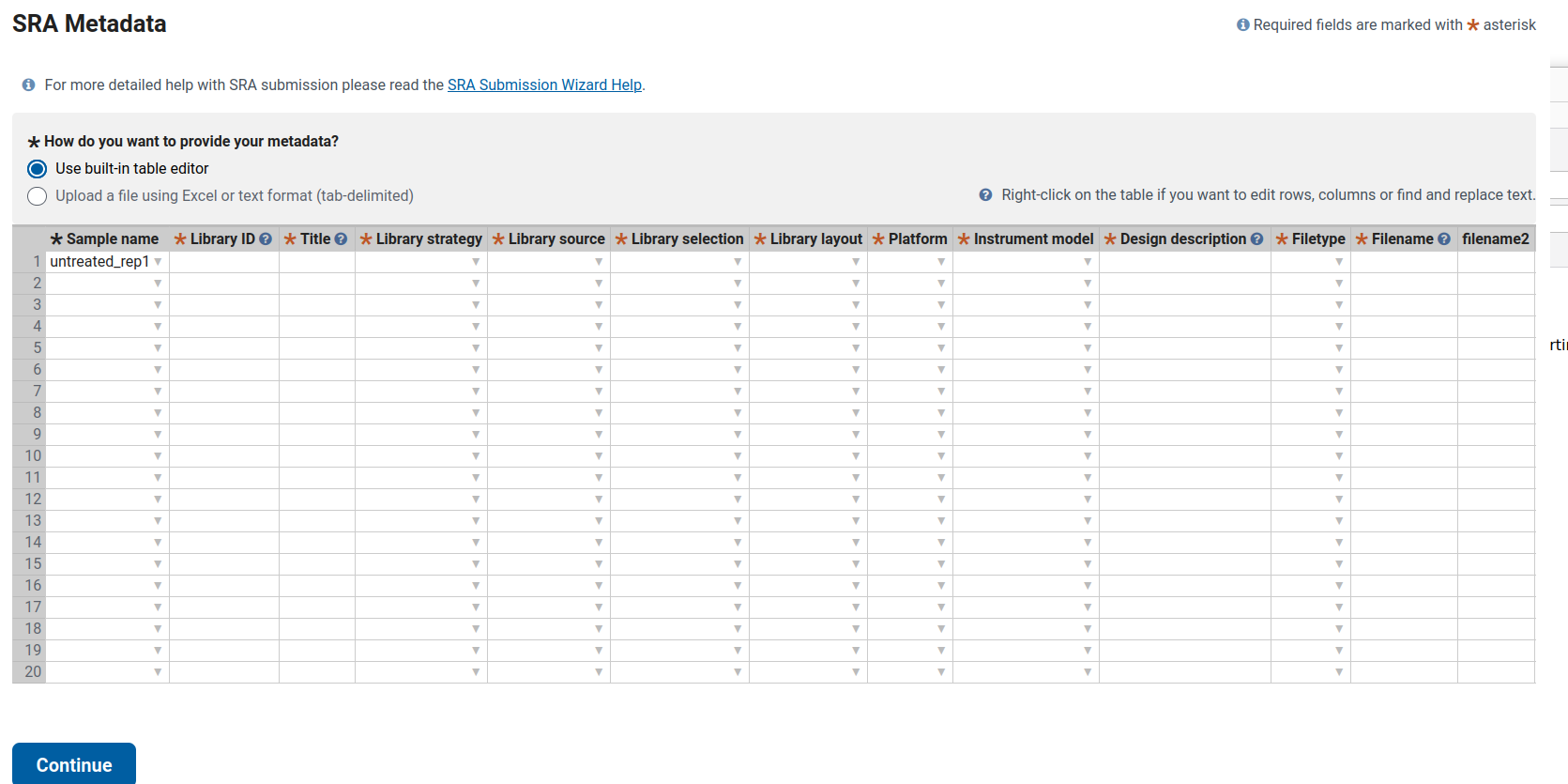
Screenshot from 2025-12-09 14-31-53

This guide explains how to complete the SRA metadata table for ten bulk RNA-seq samples derived from human skin organoids (SkOs). It includes one fully filled example row and shows the pattern to follow for the remaining samples.

Columns That Are the Same for All 10 Samples

According to the Methods section, all samples correspond to bulk RNA-seq using Lexogen RiboCop rRNA depletion and the Lexogen RNA-Seq V2 library kit. Sequencing was performed as single-end 1×83 bp reads on the Illumina NextSeq 500. Therefore, the following columns remain identical for all samples (untreated_rep1HSV_d8_rep2):

  • Library strategy: RNA-Seq
  • Library source: TRANSCRIPTOMIC
  • Library selection: RANDOM (rRNA-depleted total RNA; “RANDOM” is the standard choice)
  • Library layout: SINGLE
  • Platform: ILLUMINA
  • Instrument model: Illumina NextSeq 500
  • Filetype: fastq (use this if uploading *.fastq.gz; otherwise, select the matching file type)

Columns That Differ Per Sample

  1. Sample name This information comes from BioSample (e.g., untreated_rep1, HSV_d4_rep2, etc.).
  2. Library ID Each row must have a unique internal ID. You can use a simple sequential pattern:
untreated_rep1 → LIB01  
untreated_rep2 → LIB02  
HSV_d2_rep1   → LIB03  
…  
HSV_d8_rep2   → LIB10

Alternatively, a more descriptive format such as SkO_bulk_untreated_rep1 is acceptable. The key requirement is that all IDs are unique.

  1. Title Use the following pattern: Bulk RNA-seq of human skin organoid (SkO), CONDITION, replicate X

Examples:

untreated_rep1 → Bulk RNA-seq of human skin organoid (SkO), untreated, replicate 1  
untreated_rep2 → Bulk RNA-seq of human skin organoid (SkO), untreated, replicate 2  
HSV_d2_rep1   → Bulk RNA-seq of human skin organoid (SkO) infected with Human alphaherpesvirus 1 (HSV-1), 2 dpi, replicate 1  
HSV_d4_rep2   → Bulk RNA-seq of human skin organoid (SkO) infected with Human alphaherpesvirus 1 (HSV-1), 4 dpi, replicate 2  

Repeat this pattern for 6 dpi and 8 dpi samples.

  1. Design description Use this base text and modify it per condition:

    Bulk RNA-seq of human hair-bearing skin organoids (SkOs) derived from hiPSC line UKEi001-A. Total RNA from two organoids per condition was pooled, depleted of rRNA (Lexogen RiboCop rRNA Depletion Kit for Human/Mouse/Rat V2), and libraries were prepared with the Lexogen RNA-Seq V2 Library Prep Kit with UDIs (short insert variant). Libraries were sequenced as 1×83 bp single-end reads on an Illumina NextSeq 500.

Then append the condition information as follows:

  • For untreated rows: Condition: untreated control.
  • For HSV_d2 rows: Condition: skin organoids infected with Human alphaherpesvirus 1 (HSV-1) for 2 days (2 dpi).
  • For HSV_d4 rows: Condition: skin organoids infected with Human alphaherpesvirus 1 (HSV-1) for 4 days (4 dpi).
  • Continue the same pattern for 6 dpi and 8 dpi.
    1. Filename / filename2 Since this dataset is single-end, only the Filename column is required.
  • Filetype: fastq
  • Filename: must match the exact uploaded file name, e.g.:
untreated_rep1 → untreated_rep1.fastq.gz  
untreated_rep2 → untreated_rep2.fastq.gz  
HSV_d2_rep1   → HSV_d2_rep1.fastq.gz  
…
- **filename2:** leave blank (used only for paired-end libraries).

Example: Completed Row (untreated_rep1)

Column Example Entry
Sample name untreated_rep1
Library ID LIB01
Title Bulk RNA-seq of human skin organoid (SkO), untreated, replicate 1
Library strategy RNA-Seq
Library source TRANSCRIPTOMIC
Library selection RANDOM
Library layout SINGLE
Platform ILLUMINA
Instrument model Illumina NextSeq 500
Design description Bulk RNA-seq of human hair-bearing skin organoids (SkOs) derived from hiPSC line UKEi001-A. Total RNA from two organoids per condition was pooled, depleted of rRNA (Lexogen RiboCop rRNA Depletion Kit for Human/Mouse/Rat V2) and libraries were prepared with the Lexogen RNA-Seq V2 Library Prep Kit with UDIs (short insert variant). Libraries were sequenced as 1×83 bp single-end reads on an Illumina NextSeq 500. Condition: untreated control.
Filetype fastq
Filename untreated_rep1.fastq.gz
filename2 (blank)

After completing this first row, copy and adjust the fields (Library ID, Title, Design description condition, and Filename) for the other nine samples accordingly.

Varicella-Zoster Virus in Complex Skin Organoids

Varicella-Zoster Virus (VZV) in complex skin organoids is about using advanced 3D human skin models to understand how VZV infects, spreads, and interacts with host immunity in its most relevant organ: the skin. 这些类器官尽量重建了人皮肤的层次结构和细胞多样性,使得对VZV的研究比传统二维细胞培养更接近真实感染情境。2345

为什么皮肤和类器官重要

VZV 的致病性高度依赖其在表皮角质形成细胞中的复制,这最终形成充满高滴度游离病毒的水疱,是人际传播和建立潜伏感染的关键步骤。 传统小鼠模型难以完全模拟人特异性VZV感染,因此发展成人皮肤组织模型、皮肤器官培养以及皮肤类器官对于研究病毒复制、皮损形成和疫苗株减毒机制至关重要。67482

复杂皮肤类器官是什么

复杂皮肤类器官通常来源于人多能干细胞或皮肤前体细胞,经过定向分化形成多层表皮、真皮样结构,有时还包括毛囊、皮脂腺甚至神经和免疫细胞成分。 这些3D结构提供了立体组织环境和细胞间相互作用,可以更真实地研究VZV在不同表皮层的扩散、跨层传播以及向神经末梢的进入过程。34952

在类器官中研究VZV复制与传播

类器官允许模拟病毒从基底层角质形成细胞开始复制,再向上层分化细胞扩展的过程,这与患者皮损中观察到的VZV复制模式高度一致。 通过在类器官中接种标记VZV,研究者可以动态监测病毒如何在组织内扩散、形成局灶性病灶,以及是否存在类似体内那样的“离散水疱”样病变。7410862

免疫控制与固有限制因子

皮肤类器官为研究VZV如何与局部固有免疫和限制因子(如干扰素通路、自噬、PML核小体等)互作提供平台。 通过在类器官中操纵这些信号(例如阻断或增强I型干扰素、改变角质形成细胞分化相关通路),可以评估这些因素如何影响病毒复制强度、病灶大小以及病毒向神经末梢的传播能力。4111052

向神经系统的连接与潜伏相关模型

VZV最终在感觉神经节建立潜伏,因此将皮肤类器官与人源神经元或神经类器官连接,是当前研究中的一个重要发展方向。 一些工作利用人神经元或神经类器官模型,已经显示可以在体外建立VZV潜伏和再激活系统,未来与皮肤类器官耦合可更好模拟“皮肤–神经–神经节”轴上的完整生命周期。1213514

与其他模型相比的优势和局限

与单层细胞相比,皮肤类器官在细胞多样性、分化梯度和屏障特性方面更接近真实皮肤,因此对药物筛选、毒力基因鉴定以及疫苗株特性分析更具生理相关性。 不过,当前类器官通常缺乏完整血管系统和成熟适应性免疫成分,这限制了对全身免疫反应和T细胞介导控制的模拟,需要与动物模型或临床数据结合解读。15562

如果你愿意,可以继续围绕这个主题细化几个环节,例如:

  • “如何在皮肤类器官中设计VZV基因功能筛选实验?”
  • “如何把类器官数据嵌入到系统层面的病毒–宿主互作网络分析?” 161718192021

模型系统与方法学

  • 您所使用的复杂皮肤类器官在多大程度上重建了体内人皮肤的关键特征,例如分层结构、屏障形成、神经支配以及驻留免疫细胞?这些模型在解释VZV传播和免疫逃逸数据时目前主要的局限在哪里?
  • 您是如何将经典病毒学方法与对受感染皮肤和神经类器官的多组学分析相结合,用于刻画VZV–宿主相互作用的时间动态?在区分“早期限制”与“成功免疫逃逸”方面,哪些读出指标被证明最具信息量?
  • 在稳定感染复杂皮肤和周围神经系统类器官时,使用报告病毒时遇到的主要技术挑战是什么?您如何验证类器官中观察到的传播模式以及潜伏/再激活特征能够真实反映人皮肤和感觉神经节中的情况?

皮肤与神经中的传播

  • 在您的比较分析中,皮肤类器官与神经类器官之间是否存在不同的细胞间传播方式或动力学?是否有特定的病毒基因或宿主通路在这两个解剖部位对传播发挥了差异化的调控作用?
  • 在类器官不同表皮层中,病毒基因表达谱(例如基底层的立即早期基因与上层角化细胞的晚期糖蛋白表达)与体外或体内人皮肤模型中的描述有多接近?这对确定最有效的干预靶点有何启示?
  • 与以往的皮肤器官培养或SCID-hu小鼠模型相比,类器官模型是否帮助澄清了VZV何时以及通过何种方式进入皮肤中的感觉神经末梢并建立潜伏感染?

先天限制因子与固有免疫

  • 您提到已有工具用于研究POL III和PML核小体等限制因子;在皮肤微环境的类器官感染中,这些因子与VZV之间的相互作用有何新发现?VZV采用了哪些机制在局部对这些固有防御进行反制?
  • 在您的筛选中,是否发现了特异于表皮或特异于神经元的关键抗病毒蛋白?它们的表达模式是否能解释体内水痘皮损呈离散分布且单个皮损大小受限的现象?
  • 在类器官中阻断I型干扰素信号后,皮损大小及病毒产生量与既往异种移植实验相比有何差异?这一结果是否提示了VZV针对某些新的候选通路进行免疫逃逸?

免疫逃逸与免疫调控

  • 在皮肤和神经类器官中,VZV是否同样能重现hiPSC来源神经球模型中报道的那种对干扰素信号和抗原呈递的深度抑制,例如ISG诱导减弱以及MHC II相关基因(如CD74)下调?
  • 有研究显示VZV可以重塑T细胞表面标志促进其向皮肤归巢;在您的类器官微环境中,是否观察到类似的趋化因子、整合素或黏附分子改变,从而有利于组织内传播?
  • 与传统二维角质形成细胞培养相比,在三维皮肤类器官中,VZV对表皮分化通路(例如K10降解以及对kallikrein家族的调控)的影响有何不同?这是否改变了我们对水疱形成及病毒排出的认识?

病毒基因与分子机制

  • 通过类器官感染,对于特定病毒蛋白(如与PML核小体互作的ORF61)在决定皮肤趋向性、皮损形态以及溶菌性感染与免疫识别之间平衡中的作用,有哪些新的机制性见解?
  • 近期多蛋白组学研究绘制了大量VZV–宿主蛋白互作网络;在类器官中,您验证了其中哪些互作具有功能意义?是否有出乎意料的宿主靶点被发现是调控传播或免疫逃逸的关键节点?
  • 是否存在这样的病毒功能:在二维细胞培养中似乎可有可无,但在复杂皮肤类器官中却被证明对有效复制或传播是必需的,从而提示存在皮肤特异的毒力因子?

转化应用与未来方向

  • 您如何展望利用皮肤和神经类器官作为VZV下一代疫苗或抗病毒药物的前临床评估平台,特别是那些旨在增强局部先天免疫应答或阻断特定免疫逃逸机制的策略?
  • 鉴于人群中VZV相关疾病存在显著个体差异,您是否计划构建患者来源或基因分型分层的类器官面板,用以研究宿主遗传背景如何塑造限制因子表达以及对免疫逃逸的易感性?
  • 在您看来,就VZV皮肤发病机制和免疫控制的若干悬而未决问题而言,类器官模型在未来几年最有优势回答的是哪些问题?哪些问题仍然必须依赖体内或临床研究来解决?

如果你希望,我也可以把这些问题进一步压缩成适合现场快速提问的精简版要点。 211345678910

Here are example seminar questions you could ask, focused on newly advanced work using complex skin (and neuronal) organoids for VZV spread, immune control, and evasion.

Model system and methodology

  • How do the complex skin organoids used in your project recapitulate key in vivo features of human skin, such as stratification, barrier formation, innervation and resident immune cells, and what are the main limitations that still affect interpretation of VZV spread and immune evasion data?24
  • Could you elaborate on how you combined classical virology with multi‑omics in infected skin and neuronal organoids to map VZV–host interactions over time, and which readouts turned out to be most informative for distinguishing early restriction from successful immune evasion?112
  • What were the main technical challenges in stably infecting complex skin and PNS organoids with reporter VZV, and how did you validate that the observed spread patterns and latency/reactivation features reflect the situation in human skin and sensory ganglia?42

Viral spread in skin and neurons

  • In your comparative analysis, did you observe distinct modes or kinetics of cell‑to‑cell spread in skin versus neuronal organoids, and are there specific viral genes or host pathways that differentially control spread in these two compartments?24
  • How closely does the pattern of viral gene expression across epidermal layers in organoids (immediate‑early in basal cells versus late glycoproteins in suprabasal layers) mirror what has been described in ex vivo or in vivo human skin, and what does that tell us about where intervention would be most effective?94
  • Have organoid models helped to clarify when and how VZV gains access to sensory nerve endings in skin and then establishes latency, compared with earlier skin organ culture or SCID‑hu mouse data?549

Innate restriction factors and intrinsic immunity

  • You mentioned established tools to study POL III and PML nuclear bodies as restriction factors; what have organoid infections revealed about how VZV counters these particular intrinsic defenses in the skin microenvironment?72
  • Are there epidermis‑specific or neuron‑specific antiviral proteins that emerged as key restriction factors from your screens, and how do their expression patterns correlate with discrete lesion formation and limited lesion size seen in vivo?42
  • How does blocking type I interferon signaling in organoids affect lesion size and viral yield compared with earlier xenograft experiments, and does this reveal any new candidate pathways that VZV targets for immune evasion?94

Immune evasion and modulation

  • To what extent do skin and neuronal organoids reproduce the profound suppression of interferon signaling and antigen presentation that has been reported in hiPSC‑derived neurospheroids, for example reduced ISG induction and MHC class II–associated genes such as CD74?682
  • Some studies show that VZV remodels T‑cell surface markers to promote skin homing; have similar VZV‑driven changes in chemokines, integrins or adhesion molecules been observed within the organoid microenvironment that might facilitate intra‑tissue spread?29
  • How does VZV manipulation of epidermal differentiation pathways (e.g., degradation of K10 and modulation of kallikreins) look in your 3D organoids compared with traditional monolayer keratinocyte cultures, and does this change how we think about blister formation and virus shedding?4

Viral genes and molecular mechanisms

  • What new insights have organoid infections given into the role of specific viral proteins such as ORF61 (and its interaction with PML nuclear bodies) in determining skin tropism, lesion morphology, and the balance between lytic replication and immune detection?79
  • Recent multi‑proteomic surveys mapped dozens of VZV–host protein interactions; which of these interactions have you been able to validate functionally in organoids, and did any unexpected host targets emerge as central nodes for controlling spread or immune evasion?112
  • Have you identified viral functions that appear dispensable in 2D cell culture but are clearly required for efficient replication or spread in complex skin organoids, suggesting skin‑specific virulence determinants?72

Translational and future directions

  • How do you envision using skin and neuronal organoids as preclinical platforms to test next‑generation VZV vaccines or antivirals, particularly those aimed at enhancing local innate responses or blocking specific immune‑evasive mechanisms?592
  • Given the inter‑individual variability in human VZV disease, do you plan to develop patient‑derived or genetically stratified organoid panels to study how host genetics shapes restriction factor expression and susceptibility to immune evasion?112
  • Which open questions about VZV skin pathogenesis and immune control do you think organoid models are best positioned to answer in the next few years, and where will in vivo or clinical studies still be indispensable?924

310


  1. https://gepris.dfg.de/gepris/projekt/566297691?language=en 

  2. https://pubmed.ncbi.nlm.nih.gov/20563710/ 

  3. https://pmc.ncbi.nlm.nih.gov/articles/PMC9147561/ 

  4. https://pmc.ncbi.nlm.nih.gov/articles/PMC1193618/ 

  5. https://pubmed.ncbi.nlm.nih.gov/39351233/ 

  6. https://journals.asm.org/doi/full/10.1128/mmbr.00116-22 

  7. https://www.frontiersin.org/journals/immunology/articles/10.3389/fimmu.2024.1458967/full 

  8. https://pmc.ncbi.nlm.nih.gov/articles/PMC10521358/ 

  9. https://www.mhh.de/hbrs/zib/students/current-students/students-2025 

  10. https://pmc.ncbi.nlm.nih.gov/articles/PMC12313529/ 

  11. https://www.frontiersin.org/journals/immunology/articles/10.3389/fimmu.2024.1458967/full 

  12. https://www.pnas.org/doi/10.1073/pnas.0404016101 

  13. https://www.pnas.org/doi/10.1073/pnas.1522575113 

  14. https://journals.asm.org/doi/abs/10.1128/mmbr.00165-25?af=R 

  15. https://gepris.dfg.de/gepris/projekt/566297691?language=en 

  16. https://www.sciencedirect.com/science/article/pii/S2452199X22003942 

  17. https://pdfs.semanticscholar.org/e17b/a7a1fdbfe08e310c314e41e61f40cf3a35e2.pdf 

  18. https://www.pnas.org/doi/10.1073/pnas.1111333108 

  19. https://ouci.dntb.gov.ua/en/works/9JpyNQ34/ 

  20. https://www.tandfonline.com/doi/full/10.1080/21645515.2025.2482286